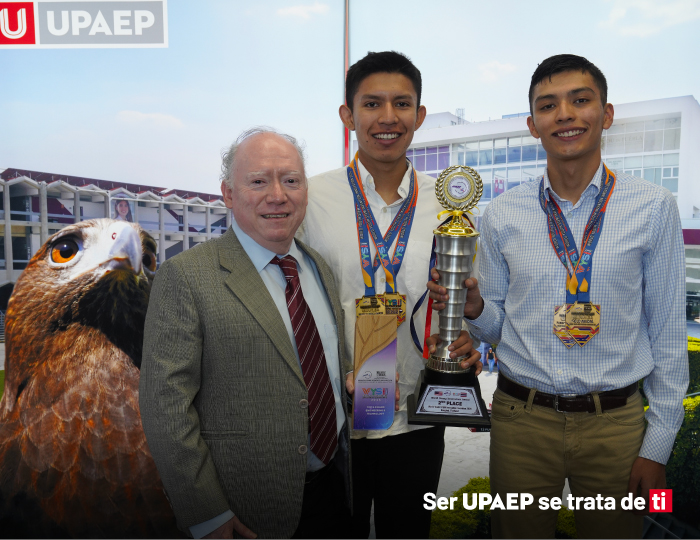
Mauro Castrejón and Farid Hernández earned first place in their category and second place overall at the World Youth STEAM Invention & Innovation competition with their project “OTIS.”
Can a university project help save thousands of lives in the face of a Category 5 hurricane? This was the question that inspired Mauro Axel Castrejón Claudio and Farid Hernández Castillo, students from UPAEP University, to develop an innovative solution that earned them first place in the Engineering and Technology category at the World Youth STEAM Invention & Innovation (WYSII) 2026 competition.
The event, held in Bangkok, Thailand, from January 29 to February 2, brought together more than 940 teams from Europe, Asia, and the Americas. The Mexican students, enrolled in Civil Engineering and Automotive Design, stood out as the only representatives from the American continent participating in the competition.
From the Tragedy of Acapulco to Success in Bangkok
The idea behind the project, named “OTIS,” was born after the devastating impact of Hurricane Otis in Acapulco in 2023.
“We saw videos of the destruction, windows shattering, and people losing their homes and belongings,” the students recalled when explaining their initial motivation.
Under the mentorship of Dr. Luis Zárate, the team developed a panel-based protection system designed to safeguard the most vulnerable parts of buildings and homes, such as windows and doors. The primary objective of the project is to protect human lives and reduce material damage in coastal areas prone to extreme weather events.
Social Engineering with Sustainable Materials
What makes “OTIS” unique is its strong commitment to social accessibility, as the team plans to use recycled PET as the main manufacturing material.
“We want the production cost to be low so that people can realistically access and install this system,” explained Farid Hernández.
To validate the system’s resistance, the students used Computational Fluid Dynamics (CFD) and conducted wind tunnel testing. This advanced methodology allowed them to simulate the extreme conditions of a hurricane without leaving the university’s laboratories.
A Victory for Mexican Talent
In addition to winning first place in their category, Mauro and Farid received the World Young Innovation Award, ranking as the second-best project overall in the entire competition. They were also honored with the Panel’s Choice Award, granted by the competition’s panel of judges.
During the award ceremony, the moment was filled with pride as the students stepped onto the stage carrying the Mexican flag, representing their country among delegations from around the world.
“It was a moment of realization, seeing that all the hours of work—even during our vacation time—had paid off,” shared Mauro Castrejón after the victory.
The team is now in the process of patenting the technology, with the goal of bringing the solution to market and implementing it in high-risk coastal regions.
This achievement represents not only an academic success, but also a powerful example of how Mexican science and innovation can offer global solutions with a strong human and social impact.